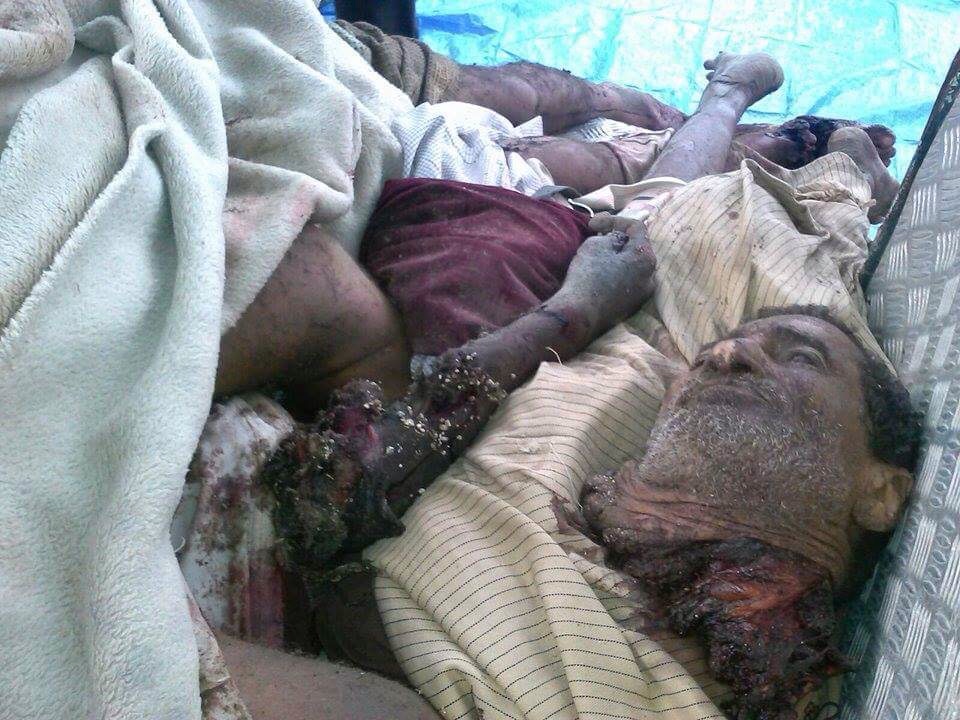
On the 13th December 2015, the Saudi led coalition airstrikes bombarded Ghaza village in Harad district in Hajaah province with over 3 raids. The initial death toll was 30 killed and one injured. Women, children and the elderly were among the victims. It was reported that civilian houses were hit and then paramedics and those in cars trying to rescue the victims were also targeted by a double tap strike,
A media representative couldn’t bear looking at a decapitated body of a child while capturing footage. One neighbour commented “The Kingdom of Saudia Arabia have bombed very poor people who don’t even have enough money to buy bread. They are considering us an experiment field, trying out all sorts of weapons from the overcrowded American and European warehouses.”
WARNING: the media below is graphic and distressing.
It is placed here as evidence as war crimes to call for an independent
investigation and to call on the international community to respect the
Arms Treaty by stopping the supply of weapons to Saudi Arabic as they
are clearly targeting civilians.
On the 24th November 2015, the Saudi led coalition launched 4 consecutive airstrikes on a residential area in the Aham district of Hajjah governorate in Yemen, destroying 2 adjacent homes housing 4 families. Bodies from the family of Mr Naser Monser Alhaj were retrieved and other families were believed to still be buried under the rubble at the time of the video report below.
Distraught eye witnesses in the video call on Muslims around the world to question if daily bombardments with 5 to 6 raids is acceptable by God and the Prophet.
The Legal Center for Rights and Development based in Yemen later confirmed that at least 10 people were killed in this incident and that 15 were injured, including 3 women and 5 children.
WARNING: the media below is graphic and distressing. It is placed here as evidence as war crimes to call for an independent investigation and to call on the international community to respect the Arms Treaty by stopping the supply of weapons to Saudi Arabic as they are clearly targeting civilians.
On 27th Sept 2015, the Saudi led coalition fired upon a small village in Zeila village in Harad district, about 100 kms to the North West of Hajja city and close to the Saudi border. At least 18 civilians were killed including 14 childrena and 4 women, and 9 were wounded including 4 children and a woman.
A first bomb landed in an empty area wounding 1 person, a second in the middle of the village but failed to detonate. Residents then fled the area and a 3rd bomb was fired on those fleeing the scene.
There were some reports that it was an Apache helicopter that fired on the fleeing civilians, however Yemeni human rights organisation Mwatana recorded the incident as 'coalition fighter jets'.
Warning: the media below is extremely graphic and distressing. It is put here as evidence to call for a UN investigation and to call on Western governments to respect the Arms Treaty by stopping the transfer of weapons to Saudi Arabia.
On the 24th September 2015, on the day of Eid, the Saudi led coalition airstrikes hit a 2 story home in Bani Aziz village in Aflah Al-Yemen district, Hajja province. 19 civilians were killed including 13 women and 6 children. There were no Houthis or any armed group in the village, just poor people with no interest in politics at all.
This is Mwatana's report of the incident: (note the date on this report is listed as 23rd but other reports and tweets of the breaking news, plus the date of Eid, indicate it actually took place on 24th not the 23rd)
On the 21st September 2015, the Saudi led coalition airstrikes dropped a bomb on the security department in the village of Dhar Abo Tayr in Al-Shagadrah district, Hajja province, Yemen. Jets then waited 40 minutes until a crowd of civilians coming back from the market had gathered to look at the damage, before dropping 4 further bombs around that area, killing at least 18 civilians including 3 children, and wounding at least 6 others including a child. Fragments of the bombs were found as far as 2.5 kms away.
These videos document the Saudi led coalition air strikes on Yemen. WARNING, they are EXTREMELY GRAPHIC and DISTRESSING. They are put here as evidence to support the call for an independent enquiry into war crimes and to call on the West to stop supplying arms to Saudi Arabia.
Early Sunday morning 30th August 2015, Saudi led coalition airstrikes hit a water bottling factory in Hajjah province, killing at least 14 workers, including 3 boys, and wounding 11 more.
This is HRW's report of the incident:
On August 30 at about 3:50 a.m., an airstrike hit Al-Sham Water Bottling Factory in the outskirts of Abs. The strike destroyed the factory and killed 14 workers, including three boys, who were nearing the end of their night shift, and wounded 11 more. Many of the dead and wounded, as well as the owner of the factory, were from the same family.
Hamza Abdu Muhammad Rouzom, 26, a factory worker present at the time of the explosion, told Human Rights Watch he was on the shift that started at 8 p.m. and was set to end at 5 a.m.:
"Because we work with noisy machines, if there were planes flying overhead, we would not have heard them. The explosion was almost like a dream, it all happened so quickly. I heard a whizzing sound for a second, then a huge explosion. I lost consciousness for at least 30 minutes, and when I woke up I saw people were trying to help me. I was covered in blood and dust and had a big cut on my right foot. They carried me to my car, and as they did, I looked around me and saw fire everywhere. I saw my friends and coworkers wounded, some completely burned. It was one of the worst moments of my life."
He was taken to a hospital in Hodaida, but because of a lack of medical supplies, was transferred to a second hospital soon after.
Khaled Ibrahim Musaed, 34, a journalist who lives about 10 kilometers (6.2 miles) from the factory, said that coalition aircraft carried out more than a dozen strikes on a range of military and government installations that night in other parts of Hajja governorate, and the strike on the factory was the last. Two workers at the plant told Human Rights Watch that this was the only strike in the direct vicinity and that they knew of no military targets close to the area.
Later on August 30, after the airstrike, Brig. Gen. Ahmed al-Assiri, the military spokesman for the coalition, reportedly told Reuters that the plant had been used by the Houthis to make explosive devices, and was not, in fact, a bottling factory. All of the individuals Human Rights Watch interviewed said that plant was being used to bottle water and was not used for any military purposes. A group of international journalists traveled to the site of the blast two days after it was hit and reported that they could not find evidence of any military targets in the area. They said that they carefully examined the site, and took photos and videos of piles of scorched plastic bottles melted together from the heat of the explosion. They could not find any evidence that the factory was being used for military purposes.