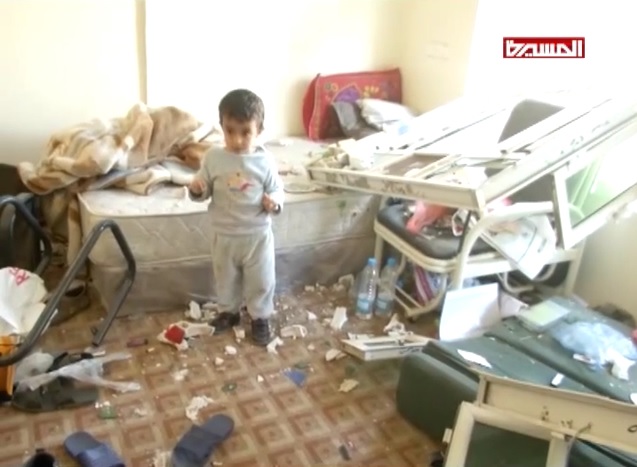
On the 7th December 2015, Saudi led coalition airstrikes bombarded civilian homes in Dhahian City, Saada province at 1 am, striking the family of Mr. Saleh Jarwan, killing two and injuring several others. Six homes and an adjoining mosque were destroyed, in addition to scores of burnt cars.
A survivor in the video below points to the house of his dead uncle, and another house of a critically injured cousin, destroyed cars and trucks in the vicinity. WARNING: the media below is graphic and distressing. It is placed here as evidence as war crimes to call for an independent investigation and to call on the international community to respect the Arms Treaty by stopping the supply of weapons to Saudi Arabic as they are clearly targeting civilians.
On the morning of 25th October, the Saudi led coalition airstrikes targeted a food warehouse located in Sanaa, Road 45, in a residential neighbourhood. The warehouse burned to the ground along with all its food contents. The bombardment also destroyed nearby homes, shops, cars and damaged the Naser Specialist Hospital where 10 patients were injured.
The video below reports that the loss of the warehouse is devastating to traders as well as to consumers, who already suffer from food shortages due to the Saudi blockade. A few meters away from the warehouse, Naser Specialist Hospital suffered similar damage to its Surgery wing, Intensive Care Unit, and Emergency center. In brief, all facilities and their medical equipment were destroyed. Ten patients were injured and had to be transferred to hospitals in the capital Sanaa.
Civilians cried angrily in response to the destruction of the food warehouse, as seen in the video, holding packets of the damaged food of children’s sweets, cakes, and potato chips. At the hospital, doctors pointed at the damaged equipment and patients’ x-rays. They are saying that Saudis are hitting randomly, targeting civilians and their basic means of survival.
On 17th October 2015, the Saudi led coalition airstrikes targeted a mosque in al Hajar village in Al Qabbaytah District, Lahj province, killing 7 people (5 inside and 2 people passing in a car outside) and injuring a further 7 people.
Airstrikes also hit Taiz International Airport badly damaging some sections.
On 19th July 2015, the Saudi led coalition airstrikes killed at least 16 civilians, including 3 women and 9 children, and injured at least 16 more, damaging and destroying at least 11 homes, in the town of Yarim in Yemen.
This is HRW's report of the incident:
At about 2 a.m. on July 19, airstrikes killed at least 16 civilians, including three women and nine children, and wounded at least 16 civilians, in Yareem town, about 120 kilometers (75 miles) south of Sanaa.
Human Rights Watch examined the site on July 22. The strike had partially damaged, and in some cases completely destroyed, 11 one-story residential homes and a two-story building.
Human Rights Watch also established that the site is located about 200 meters (219 yards) from the entrance to the 55th Rocket Artillery Brigade. Residents told Human Rights Watch that since the beginning of the air campaign in March, and on that night, they heard anti-aircraft guns being fired from the base. One nearby resident said that the now-dismantled Republican Guard, the military wing under the command of former president Ali Abdullah Saleh’s son, Ahmed Ali Abdullah Saleh, had controlled the base since 1994. The base had been the main depot of Scud ballistic missiles for the Yemeni military, the resident said, but those had been removed about four years ago, and now the main weapons at the base were artillery rockets. There had been as many as 2,000 troops at the base in the past, he said, but only 300 troops were there since current conflict started.
Local residents told Human Rights Watch that at about 1:30 a.m., three strikes hit the military base at 10-minute intervals. The fourth strike hit the residential area.
Sabah Saleh Ahmed al-Boghomy, 50, said she and her husband owned most of the houses in the neighborhood, and her relatives lived in several of them. She said she was asleep at the time of the strike and was awakened by her daughter screaming and shaking her, saying that planes were bombing the military base. Al-Boghomy tried to calm her by taking her outside:
"After we left the home, all of a sudden the windows of the house shattered and the roof collapsed. We heard a loud explosion but had no idea that it was in our own yard. At the time my three sons, their wives and children and my two [other] daughters were still inside the house…. I remember hearing my neighbor screaming, “Save my children, save me, we are under the rubble!” "
Her family survived the attack without injury, but she said she knew of at least 12 neighbors who were killed in the strike. The attack destroyed six of their family homes and three cars.
A local resident, Hana Saad al-Nazhi, told Human Rights Watch that when she heard the first explosion, she grabbed her children and hid in a small room in their home:
"We stayed in that room while all the strikes happened, so I assumed that my brothers were safe and had escaped, only to realize when I went outside that one strike had hit my brother’s house. It wiped his house to the ground, they blew it up and killed him and his daughters… What was the military target in my brother’s house?"
Another brother, Radwan Saad al-Nazhi, came to the site of the strike after hearing the blasts from his home, located a few streets away. He told Human Rights Watch that altogether eight members of two of his brothers’ families were killed, five of them children. His sister, Hana Saad al-Nazhi, and her children were the only ones who survived the airstrike, but with injuries:
"I am not employed, my brothers were, I am not. I make a living doing odd jobs in the streets.… I had to take my sister and her three kids out of the hospital because I could not pay their bill."
Muhammad al-Faqih, 45, said he was sitting in his living room when he heard the initial strikes on the military base. He grabbed his clothes and woke his five children and wife, telling them to get dressed and be ready to leave. His son Osama al-Faqih, 20, was walking down the steps out of the house just as the strike hit about 20 meters (7 feet) from the door of their home. Muhammad al-Faqih, standing behind him just inside the door, was blown back into the house:
"We scrambled to our feet and got out of the house, and I heard cries. I turned to my left and saw my neighbor, an older woman. She was lying on the ground, with a large rock crushing her legs. She was begging us to help her so we did. After we helped move it, we rushed off to get my son, who we realized was injured, to the hospital. As we got to the main road we saw another neighbor, Salma, wandering along, and wailing for help. She was badly burned and her head was open and gushing blood.… I don’t know what happened to her."
Osama had a metal shard lodged in his neck that the doctors planned to remove, Muhammad al-Faqih told Human Rights Watch. He said that they were lucky that other families had helped to pay their medical bill. His house was only slightly damaged by the strike.
Ali Muhammad al-Milah was in his house, which was destroyed in the strike, at the time of the blast:
"I didn’t see anything when the explosion happened, it was all black. My ears started ringing, they are still ringing now, days later. I came back the next morning and saw five bodies just lying on the ground, including the bodies of two young kids. Only yesterday when I was here they found the body of another kid, a young girl. They pulled her out of the rubble."
Another resident said he heard a fifth strike about 10 minutes later, again on the military base.
The military base was a legitimate military target. The attack that struck the residential neighborhood should be investigated by the coalition to determine if it was unlawfully targeted and whether all feasible precautions had been taken to minimize civilian loss of life and property.
WARNING: the media below is graphic and distressing.
It is placed here as evidence as war crimes to call for an independent
investigation and to call on the international community to respect the
Arms Treaty by stopping the supply of weapons to Saudi Arabic as they
are clearly targeting civilians.
A brief translation of the above news reports is as follows:
Saudi warplanes have bombed Harat Al Salol in the city of Yarim in Ibb province, killing 13—five women,five children and three men and injuring 23 others. The raid was carried out on Sunday morning on a residential neighborhood, attacking the main street and a market at the entrance of Yarim city with 5 missiles. That resulted in the destruction of 11 homes and damaged scores of adjoining buildings and houses. The city is facing difficulties in providing rescue services and medical aid due to insufficient resources and the crowding of victims at the city hospital. Scarcity of medical supplies in health centers and the critical conditions of the injuries contribute to expectations of a rising death toll.
On the 16th June 2015, the Saudi led coalition airstrikes bombed 2 vehicles killing 11 civilians including a woman, and injuring 6 including 2 women and a child, on the road that goes through Khabt Al-Rejaa in Tor Al-Baha district in Lahj, Yemen.
On 13th June 2015, the Saudi led coalition airstrikes hit the Yesnem local market in Baqim directorate in the governorate of Saadah. The initial casualty count at the time of the report was 10 killed and at least 19 injuured. Friday is a particularly busy day at market places in Yemen since people tend to do their shopping before and after their Friday prayers at the mosque.
This is a brief translation of the main points in the following video report:
Friday, a weekly holiday when people do their errands, and a Muslim holy day of worship. In the early morning hours, the Saudi-led coalition bombarded the Yasnem local market, at Baqim Directorate,in the Governorate of Saada, when it was busy with both shoppers and worshipers. The raid killed 10 and injured 19, though this is only the initial estimate of casualties. There were three strikes. The first two strikes were consecutive and then there was a pause. After about 15 minutes, as people emerged to assist survivors, a third strike came unexpectedly, hitting both the initial victims and their would-be rescuers. Shops and cars were destroyed as well. There are still families searching in despair for their missing loved ones among the chaos of dismembered bodies.
On 15th April 2015, the Saudi led coalition airstrikes struck a petrol station in Saada City where approximately 50 cars were waiting for petrol. At least 5 people were identified as killed in the attack and 23 injured, although it is likely many more (at least 8 people were reported as too badly burnt to be identified).
This is the Human Rights Watch report of the incident:
Jarman Petrol Station
On April 15, at least one aerial bomb struck the Jarman petrol station in western Saada City, killing at least five people and injuring 23 – though likely many more -- who were waiting in line to fill their cars with gasoline. Abed Abd al-Rahman Ali, 23, a car mechanic, told Human Rights Watch that about 50 cars were lined up outside the petrol station, known as the Jarman Station, next to his workshop.The combined effect of the war and the coalition blockade had created long lines at petrol stations all over Yemen. Ali said he heard an airplane overhead at about 1 p.m. and then a loud explosion. A bomb had hit the gas station’s roof, causing it to collapse in a fireball that incinerated some of the vehicles. Ali, who said he ran out to help the wounded, described a chaotic scene at the station: “I saw four sets of limbs completely severed so we don’t know who they belonged to.” Ansar Allah’s civil affairs office provided Human Rights Watch the names of five people who died in the attack and 23 wounded. Medical personnel told Human Rights Watch that they were not able to identify eight people after the attack because they were too badly burned, indicating a higher casualty figure.
Witnesses described seeing many victims after the attack. Ali said that he saw about 15 to 20 bodies on the ground and about 20 to 25 people with burns and fragmentation wounds. His brother, Osamah Abd al-Rahman Ali, told Human Rights Watch he arrived at the scene minutes after the strike and saw at least eight bodies, including some with severed limbs, and 16 wounded.
Human Rights Watch was also not able to establish how many of those killed were civilians. The Ansar Allah civil affairs office told Human Rights Watch that the people whose deaths they had documented were all civilians. Ali told Human Rights Watch that he did not see anybody at the station carrying weapons. Another Saada resident, however, told Human Rights Watch that the Houthis used the Jarman petrol station as the main one at which to refuel their vehicles.
Satellite imagery recorded around 10:30 a.m. on April 15, about two and a half hours before the airstrike, shows a line of several dozen vehicles stretching approximately 175 meters from the petrol station. The vehicles appear small in size consistent with passenger cars and pickup trucks. Satellite imagery recorded on May 2 shows extensive building destruction and fire-burned cars surrounding the petrol station consistent with the detonation of aerial munitions and secondary fuel tank fires.
During its investigation of the site, Human Rights Watch found that the concrete overhang above the petrol pumps had collapsed, consistent with witnesses’ claims that a bomb struck the roof. There were seven burned-out vehicles in close proximity to the station. All of the vehicles appeared civilian. Five of the vehicles were small passenger mini-buses. Two cars were regular personal cars. Photos from the immediate aftermath of the attack that Human Rights Watch reviewed do not show any additional vehicles that would appear to be military.
Because of the importance of fuel for military operations, depriving belligerent forces of fuel supplies is a legitimate military objective. Even so, for the coalition to attack a petrol station in the middle of the day when it could reasonably be determined that many civilians were present, instead of at night and after providing a specific warning, is contrary to the obligations to take all feasible precautions to minimize civilian harm and may amount to an unlawfully indiscriminate or disproportionate attack.
The following daily report by the Legal Center for Rights and Development confirm the strike on Jarman petrol station including many casualties from this incident plus many other incidents that same day.
The following videos from Almasirah TV include footage from the incident. WARNING: the following videos are graphic and distressing.
They are put here as evidence of war crimes, to call on the UN for an
independent inquiry, and to call on Western governments to honour the
Arms Treaty and to stop the supply of weapons to Saudi Arabia.