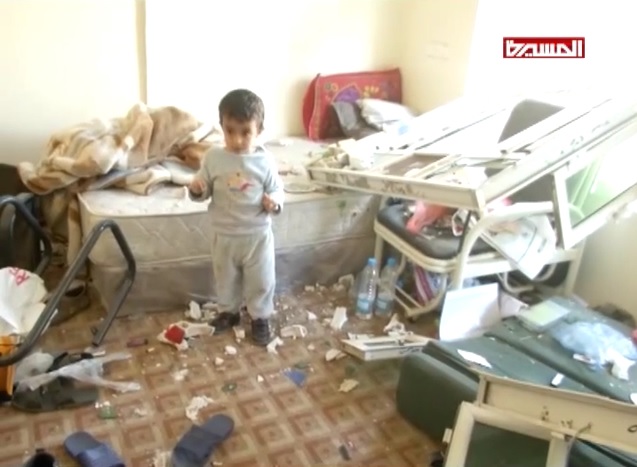
On the morning of 25th October, the Saudi led coalition airstrikes targeted a food warehouse located in Sanaa, Road 45, in a residential neighbourhood. The warehouse burned to the ground along with all its food contents. The bombardment also destroyed nearby homes, shops, cars and damaged the Naser Specialist Hospital where 10 patients were injured.
The video below reports that the loss of the warehouse is devastating to traders as well as to consumers, who already suffer from food shortages due to the Saudi blockade. A few meters away from the warehouse, Naser Specialist Hospital suffered similar damage to its Surgery wing, Intensive Care Unit, and Emergency center. In brief, all facilities and their medical equipment were destroyed. Ten patients were injured and had to be transferred to hospitals in the capital Sanaa.
Civilians cried angrily in response to the destruction of the food warehouse, as seen in the video, holding packets of the damaged food of children’s sweets, cakes, and potato chips. At the hospital, doctors pointed at the damaged equipment and patients’ x-rays. They are saying that Saudis are hitting randomly, targeting civilians and their basic means of survival.
On Saturday 19th September 2015, Saudi led coalition air strikes hit a market place in the region of All-Mougenia in Munabbih, Saada province. It was a busy time with shopkeepers, vendors and shoppers as it was the week before Eid al-Adha and people had gone out to buy what they needed for the holy celebration. Up to 90 people (initially the figure was 72 but later the figure rose to 90) were killed and 14 injured. Witnesses say that the raid resulted in people being cut to pieces, bodies were burning in the street and all the shops were also destroyed. http://kayhan.ir/en/news/18590/six-months-of-saudi-strikes-kill-over-6000-in-yemen http://alistairreignblog.com/2015/09/26/httpwp-mep6khlz-af/
These videos document the Saudi led coalition air strikes on Yemen. WARNING, they are EXTREMELY GRAPHIC and DISTRESSING.
They are put here as evidence to support the call for an independent
enquiry into war crimes and to call on the West to stop supplying arms
to Saudi Arabia.
On 27th August 2015, the Saudi led coalition airstrikes killed at least 18 civilians including 6 children and wounded at least 16 others including 6 children and 3 women when they bombed a petrol station next located at a central community meeting place next to shops and a mosque. The whole area was devastated as a result and now remains vacant as most of the people fled elsewhere to live in far away villages.
On 20th July 2015, the Saudi led coalition airstrikes struck a school, gas station, shops and a playground in Al-Dhale governorate killing up to 5 people including 2 children, and injuring 13 more.
This is what Médecins Sans Frontières reported:
'On 20 July, in Al-Dhale governorate airstrikes from early morning until mid-day targeted a school, a gas station and a playground. The Emergency Room in the MSF supported hospital received 14 civilians, among them a child dead on arrival to the hospital.'
A brief translation of the above video news report is as follows:
On the 20th of July, from the early morning till mid-day, Saudi Airstrikes bombarded residential homes, commercial shops, a school and a gas station in several areas in Qataba province, Al-Dhale governorate. Five were killed, three from the same family, a father and two children. Residents said three missiles were fired on a residential house and asserted that Saudis are appearing to be targeting civilians possessions such as homes, cars and shops, since their area does not contain any army camps, soldiers or Houthis.
On 3rd July 2015, the Saudi led coalition carried two air aids on the South East of Al Hudaydah governorate. They targeted the Directorate of Security, a mosque, shops and a densely populated residential area. After the first raid, whilst people had gathered to rescue the injured, the jets returned to carry its second raid on the first responders.
3 adults and 1 child were declared dead and over 25 people injured. The man on the video dressed in orange, who has lost his son in the tragedy, said raids will not undermine the Yemeni spirit to fight the aggression, while the rest of the crowed expressed their outrage at Saudi Arabia, condemning president Hadi’s government and everyone who collaborated with the Saudis.
On the 7th June 2015, the Saudi led coalition airstrikes targeted the Headquarters of Public Leadership in Sanaa which, was located in a densely populated area. The airstrikes destroyed nearby houses and shops. It is reported that those who went to help with rescue efforts were then targeted with further raids as there were 6 raids in total. The Legal Center for Rights and Development based in Sanaa reported 53 civilians killed and 210 others injured. Warning: the following videos are verygraphic and distressing. They are placed here as evidence to call on the UN to launch and independent inquiry and to call upon Western governments to honour the arms treaty by stopping the supply of weapons to Saudi Arabia.
The following video shows human remains that were collected in plastic bags from the streets and roof tops.
On 2nd June 2015, Saudi led coalition airstrikes hit shops on Sa'da city's main commercial street, killing 7 and injuring dozens of shop-keepers, shoppers and passers-by. This is Amnesty International's report of the incident: COMMERCIAL BUILDINGS, AL-JUMAYDA NEIGHBOURHOOD, SA’DA CITY, SA’DA, 2 JUNE
Sa’da city’s main commercial street, south and south-east of the old city, has been repeatedly targeted by coalition airstrikes and largely destroyed, killing and injuring shop-keepers and shoppers and depriving of their livelihoods hundreds of families who used to make a living from their trade there.
On the morning of 2 June, one of these airstrikes left seven dead and more than a dozen injured among shop-owners, shoppers and passers-by. Ahsan Ahmad al-Hamis, the owner of a shop selling agricultural products, described the strike to Amnesty International:
“It was about 10.30am when the strike happened. Abdulaziz Jihad Ahsan, who was 20 and had a small shop selling electrical spare parts for cars, was killed on the spot. Abdulmalik Ahmad Nasser, who worked in my shop, was also killed on the road near the shop. Another one who was killed on the street was Hamud Yahia Sayed Zalzal. In addition to them I saw three other dead men whose names I don’t know”.
Abdelsalam Ahmed Nasser told Amnesty International that his brother Abdelmalik Ahmed Nasser, 32, was a father of four young children:
“It was about 10.30am and I had gone to buy some car parts when a shop owner ran over to me and told me: ‘come quickly, your brother is injured’. There were no ambulances. We had to wait half an hour. We took him to hospital but he died. He had shrapnel injuries in his abdomen. He had been about 30 meters away from the explosion”
Abdulaziz Jihad Ahsan’s brother Shihab told Amnesty International that Abdulaziz was struck in the head by shrapnel and died instantly; and that another brother, Yasser, was also injured in the strike.
Witnesses told researchers that another airstrike a day earlier on an aluminium shop on the same street had caused further casualties.
The following report by the Legal Center for Rights and Development recorded in the region of Sa'da 6 dead and 16 injured on the attack at al-Jumayda neighbourhood (the same area as that mentioned above), in addition to 3 women being killed and 1 child injured at Al-Anad market and a house in Neshoor. It also lists other civilian deaths in other areas of Yemen as follows: Taiz: 2 deaths. Sana'a: 8 (or 10?) deaths.
On the 12th May 2015, the Saudi led coalition bombed the historical town of Zabid in Hodeidah governorate of Yemen, which is listed by UNESCO as an 'outstanding archaeological and historical site' at risk. The Legal Center for Rights and Development list 60 dead (inc13 women and 8 children) and 155 injured as a result of the bombardment.
Sites damaged or destroyed included public buildings, a public highway, a busy market place, a sweet shop, restaurants, grocery stores and a residential area next to a historical mosque. The strike on the marketplace was documented as a double tap strike where jets returned to strike the rescuers.
This is HRW's report of the incident:
At about 4:15 p.m. on May 12, aircraft dropped at least five bombs on the Houthi-controlled town of Zabid, 96 kilometers (0.6 miles) south of the western port city of Hodaida, killing at least 60 civilians, including 13 women and eight children, and wounding at least 155.
Human Rights Watch examined the site on July 26. Three of the bombs had struck a three-story building in the middle of the Shagia market. The first bomb struck a sweets shop in the building. The second strike, which witnesses said took place about five minutes later, hit a restaurant on the building’s ground floor. The third struck the building’s second floor, causing the structure to collapse. The force of the blasts also destroyed two other buildings housing another restaurant and four grocery stores.
Abdu Ahmed Thayfi, 36, a qat seller at the Shagia market, was injured in the second strike:
"I heard the first strike, and then a few minutes later, the second. I felt as if everything was spinning around me, and then it went black. I woke up and saw the muscle of my left leg torn open. My right leg bone was snapped in half. My brother Muhammad suddenly appeared and wanted to take me to the hospital, but I refused to go, because I knew they would want to amputate my leg."
Thayfi ended up having a bone transplant in his left leg and avoided an amputation.
Abdullah Amin al-Dhabi, 34, a local freelance editor, told Human Rights Watch that after hearing the explosion, he rushed to the market to find his cousin, a qat seller there:
"I saw at least 50 limbs ripped apart from the fragments of the explosion. I also saw other bodies of people I could recognize in front of the Shagia restaurant. There I saw my cousin, next to the bodies of three other people I knew: two of them were kids under the age of 12, another was a woman who used to sell bread by the door of the restaurant. Days later, we heard that neighbors were still finding the hands and heads of other victims on their roofs and their shops. The whole area stank."
Dr. Faisal Awad, chairman of the Zabid Relief Society, which led efforts to identify the dead, told Human Rights Watch that the authorities gathered 66 unidentified body parts from the marketplace.
At the same time as the strikes hit Shagia market, two bombs fell on a lemon grove about 600 meters (656 yards) from the market, and about 50 meters (54 yards) from the entrance to the home of Ahmed Bagesh, the owner of one of the restaurants destroyed in the market attack, killing nine civilians, including two women and four children. Three witnesses said that one of the two bombs did not explode, and that Houthi fighters came soon after the incident and removed the munition.
Bagesh told Human Rights Watch:
"Just as I heard the strikes on the marketplace, there were also two strikes right outside our doorway. My sister’s husband had just left our house—he had been over for a visit—and when I ran out, I found the top half of his body lying on the path by the door. The bottom half had been blown about 10 meters away."
Thabit Hamdain, 55, a qat seller at the Shagia market, told Human Rights Watch that a large public-sector textile factory about one kilometer (0.6 miles) from the market had been producing military uniforms for the Houthis, and said he suspected this was the target of the airstrike. The factory was unaffected by the airstrikes and had not been subsequently targeted by the time Human Rights Watch visited Zabid on July 26.
Hamdain noted that the day before the airstrike he recognized three mid-level Houthi commanders eating lunch in one of the restaurants in the market. Bagash, the restaurant owner, said that Houthi fighters often came to the market to buy qat and to eat at the restaurants, but they did not “hang around.” He also said there were no Houthi checkpoints near the market.
The presence of small numbers of Houthi military personnel at the market would not make the entire market a legitimate target for a bombing attack. A factory producing uniforms or others goods for the military would be a valid military target, but the workers inside would not be considered civilians directly participating in the hostilities. The coalition should conduct an investigation to determine whether the attack was unlawfully indiscriminate, whether an attack on the factory during working hours was disproportionate, and whether all feasible precautions had been taken to minimize civilian casualties.
Location: Zabid Date: 5/12/2015
Name
Gender
Age
Killed/Wounded
Ahmed Sulaiman Olian
Male
over 18
Killed
Khalil Abdu Sulaiman al-Mizgagi
Male
35
Killed
Amar Muhammad Amin al-Ahdal
Male
over 18
Killed
Bunian Ahmad Sawlah
Female
over 18
Killed
Abd al-Aziz Salem Omar Orouq
Male
30
Killed
Thabit Ahmad Qaderi
Male
over 18
Killed
Ibrahim Ahmad Hiba Makbuli
Male
over 18
Killed
Abdu Ahmad Dar
Male
over 18
Killed
Abdu Yusif Taher Marzouqi
Male
over 18
Killed
Muhammad Dawud Hakim
Male
over 18
Killed
Muhammad Izzi Abdullah Rukbi
Male
over 18
Killed
Mansour Muhammad Abdullah Mawqri
Male
over 18
Killed
Noaman Hassan Ragab
Male
over 18
Killed
Ahmed Ali Muftah Askri
Male
over 18
Killed
Ahmad Muhammad Awad Makbuli
Male
over 18
Killed
Aiman Muhammad Hassan Rami
Male
over 18
Killed
Gumala Ayash Said Derein (Uzaiti)
Female
over 18
Killed
Hassan Yahya Ismail Murahal
Male
over 18
Killed
Faisal Muharam Salman al-Shamiri
Male
over 18
Killed
Muhammad Anwar Futaini Wisabi
Male
over 18
Killed
Murad Muhammad Adam Haddi
Male
over 18
Killed
Wafa Yahya Salem Mauda Kabah
Female
over 18
Killed
Abdullah Abd al-Aziz Salem Qirshi (Orouk)
Male
3
Killed
Abdullah Abdullah Ridwan
Male
over 18
Killed
Ismail Dawud Sulaiman al-Ahdal
Male
over 18
Killed
Akram Abd al-Hamid al-Qubati
Male
30
Killed
al-Raimi al-Shaibah
Male
over 18
Killed
Bashar Hawash Daoud al-Wisabi
Male
12
Killed
BashIr Ghalib Mahdi al-Shamiri
Male
22
Killed
Bayan Ahmad Sawlah
Female
over 18
Killed
Gawad Muhammad Qaid al-Wisabi
Male
over 18
Killed
Husam Saif al-Qubati
Male
over 18
Killed
Hamoudah Wajih
Female
over 18
Killed
Salah Yahya Muhammad Ali
Male
over 18
Killed
Abd al-Hakim Muhammad Abdullah Ghalib
Male
over 18
Killed
Abd al-Rahman Abd al-Adhim Dabwan
Male
over 18
Killed
Abd al-Latif Yahya Muhammad Qurashi (Orouk)
Male
15
Killed
Fatima Salem Omar Qurashi (Orouk)
Female
30
Killed
Muhammad Abd al-Aziz Salem Qurashi (Orouk)
Male
5
Killed
Murad Faisal Muhram Salman al-Shamiri
Male
over 18
Killed
Nagib Qaid Abdu Ghalib
Male
over 18
Killed
Neima Hassan Omar Kaboub
Female
40
Killed
Haifa Abd al-Aziz Salim Qurashi (Orouk)
Female
8
Killed
Hassan Ali Qasim Marwai
Male
over 18
Killed
Waila Kamela
Female
over 18
Killed
Muhammad Abd al-Aziz Salem
Male
9
Killed
Hayfa Abd al-Aziz Salem
Female
7
Killed
Abd al-Latif Orouq
Male
18
Killed
Abdullah Bin Abdullah al-Shamiri (Bagesh)
Male
40
Killed
Faisal Muharam
Male
45
Killed
Murad Faisal Muharam
Male
12
Killed
Numan Rajab al-Khalil
Male
over 18
Killed
1st daughter of Yahya Ahmad Sawlah
Female
over 18
Killed
2nd daughter of Yahya Ahmad Sawlah
Female
over 18
Killed
Daughter of Yahya Khabah
Female
over 18
Killed
Daughter of Ayash Aziz
Female
over 18
Killed
Ibrahim (Hibah)
Male
over 18
Killed
Salah al-Shamiri
Male
over 18
Killed
Hassan Murahal
Male
35
Killed
Daughter of al-Musyab
Female
18
Killed
Abd al-Majid Muhammad Abd al-Ghani
Male
15
Wounded
Qasim Ali Qasim Akil
Male
15
Wounded
Abdullah Ahmad Abdi
Male
13
Wounded
Abdullah Salim Dawud
Male
16
Wounded
Yahya Awad Yahya Murahal
Male
15
Wounded
Khawla Salim Ali Musaib
Female
10
Wounded
Ahmad Futaini Hawis
Male
10
Wounded
Ismail Abdullah Ismail Salami
Male
15
Wounded
Bassam Muhammad Abdullah Radman
Male
14
Wounded
Zyad Rabia Muafa Galal
Male
12
Wounded
Hisham Said Ahmad Hin
Male
16
Wounded
Muhammad Abdullah Mata
Male
12
Wounded
Muhammad Ammar al-Bahr
Male
13
Wounded
Murtadha Faris Hadadi
Male
9
Wounded
Qasim Ahmad Qasim Mahwat
Male
15
Wounded
Nasim Muhammad Saghyir Talha
Male
18
Wounded
Akram Wahb Allah Hafid
Male
15
Wounded
Haitham Wahb Allah Hafid
Male
16
Wounded
Othman Muhammad Adam Saigh
Male
15
Wounded
Muhammad Ahmad Sulaiman Olian
Male
8
Wounded
Murad Kadaf Sulaiman Ashiq
Male
6
Wounded
Abdullah Abd al-Wahab al-Ahdal
Male
15
Wounded
Adil Hatim Ali Garwan
Male
12
Wounded
Ahmad Abdullah Hilal
Male
43
Wounded
Muhammad Ahmad Numari
Male
22
Wounded
Muhammad Abdu Hamza
Male
19
Wounded
Adel Hatim Ali Garwan
Male
12
Wounded
Ridhwan Abdu Ahmad Mizgagi
Male
over 18
Wounded
Hamada Ismail Futaini Kushi
Male
22
Wounded
Walid Muhammad Ali Omar Ahiaf
Male
35
Wounded
Sami Ahmad Muhammad Sulaiman Quba
Male
30
Wounded
Muhammad Fawzi Khadim al-Okli
Male
25
Wounded
Hassan Omar Ayash
Male
45
Wounded
Isam Ahmad Bahkali
Male
36
Wounded
Abdullah Sulaiman Daoud al-Wisabi
Male
25
Wounded
Asim Abd al-Ghafar Abd al-Wahab al-Maghbashi
Male
27
Wounded
Abd Al-Rahman Muhammad Badr al-Hubaishi al-Shamiri
This is a brief translation of an Almasirah TV report (video below) at that time:
The Saudi-led coalition carried out 4 raids on a popular market in the Zabid, south of Al Hodeidah, which houses a large number of local restaurants, grocery stores, super markets and khat stalls. The bombardment showered the market and nearby houses with shells, turning the streets into pools of blood and human remains. 40 people are reported dead and 56 wounded with countless missing under the rubble.
An old man appears screaming: “They killed my son in the restaurant” and another lying in a stretcher weeping “they bombed us, old people and children, they hit twice, stopped, then they bombed us twice again. Aren’t we Muslim? Why are they killing us?”
WARNING: the media below is graphic and distressing.
It is put here as evidence of war crimes, to call on the UN for an
independent inquiry, and to call on Western governments to honour the
Arms Treaty and to stop the supply of weapons to Saudi Arabia.
This is the report from the Legal Center for Rights and Development, listing names of the dead and injured and some testimonies of some of the witnesses: