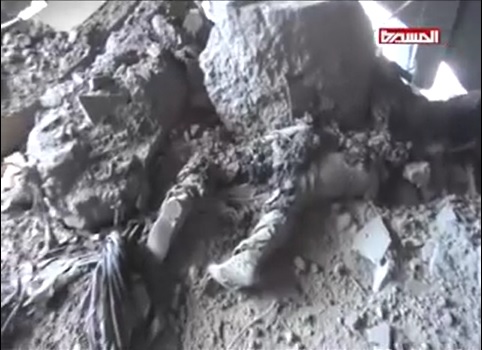
On 15th December 2015, whilst peace negotiations were taking place in Geneva, the Saudi led coalition targeted the Yemeni Oil Company in Dhamar province, killing 4 and injuring 9 employees, causing great damage to the building.
An eye witnessed declared, “This morning we were taken by surprise by the 3 raids. They have killed innocent staff on duty.” WARNING: the media below is graphic and distressing.
It is placed here as evidence as war crimes to call for an independent
investigation and to call on the international community to respect the
Arms Treaty by stopping the supply of weapons to Saudi Arabic as they
are clearly targeting civilians.
On 27th August 2015, the Saudi led coalition airstrikes killed at least 18 civilians including 6 children and wounded at least 16 others including 6 children and 3 women when they bombed a petrol station next located at a central community meeting place next to shops and a mosque. The whole area was devastated as a result and now remains vacant as most of the people fled elsewhere to live in far away villages.
On 20th July 2015, the Saudi led coalition airstrikes struck a school, gas station, shops and a playground in Al-Dhale governorate killing up to 5 people including 2 children, and injuring 13 more.
This is what Médecins Sans Frontières reported:
'On 20 July, in Al-Dhale governorate airstrikes from early morning until mid-day targeted a school, a gas station and a playground. The Emergency Room in the MSF supported hospital received 14 civilians, among them a child dead on arrival to the hospital.'
A brief translation of the above video news report is as follows:
On the 20th of July, from the early morning till mid-day, Saudi Airstrikes bombarded residential homes, commercial shops, a school and a gas station in several areas in Qataba province, Al-Dhale governorate. Five were killed, three from the same family, a father and two children. Residents said three missiles were fired on a residential house and asserted that Saudis are appearing to be targeting civilians possessions such as homes, cars and shops, since their area does not contain any army camps, soldiers or Houthis.
On 4th July 2015, the Saudi led coalition airstrikes hit a gas station, a hotel, a restaurant and a busy market place in the district of Harad in Yemen, injuring at killing at least 65 people, including at least 3 children, and injuring 105 more.
HRW reported:
At about 10 p.m. on July 4, coalition aircraft bombed the marketplace in the middle of the village of Muthalith [triangle] Ahim, about 20 kilometers south of the Saudi border in Yemen’s northwest. Because the attack occurred during the holy month of Ramadan, the area was crowded with people breaking their fast in restaurants late in the evening. The airstrike destroyed at least six buildings along the main road of the village, including a four-story building housing the Sanaa Restaurant, a small shop and hotel, and a water truck and car parked outside.
Human Rights Watch examined the site on July 24 and spoke to the staff of four hospitals that received the dead and wounded, as well as officials with the Ministry of Human Rights. The attack killed at least 65 people, including at least six African migrants and three children, and wounded at least 105. Forty of the wounded who were sent to al-Jumhouri Hospital in Hajja were suffering from metal fragment injuries, and most needed surgery, according to a nurse who was on call that night.
Muhammad Hassan, 35, a waiter at Sanaa Restaurant who was wounded in the attack, told Human Rights Watch that several hours earlier, there had been a strike on a gas station about two kilometers (1.2 miles) further north. Then, about an hour later, there was a strike on a football field about one kilometer (0.6 miles) away, and at the same time another strike on an empty building about two kilometers away. He said he had heard from some people in town that the Houthis were using the empty building to store weapons.[83] None of the other interviewees raised this allegation with Human Rights Watch.
Hassan estimated that at the time of the strike, there were about 50 people in the restaurant, and about 100 in the hotel above. Outside the restaurant, there was a large open space with fishmongers and people selling vegetables, cell phones, qat, and other items. He believed that there were also about 50 to 60 African migrants, as well as many displaced Yemenis from northern border villages, sitting on the steps of the restaurant at the time of the bombing. Hassan told Human Rights Watch:
"I was outside in the alley beside the restaurant taking out the trash when the strike hit. I saw fire and smelled gunpowder. The pressure of the explosion threw me back about 10 meters into a pile of trash bags. I tasted blood, and felt a pain in my chest, and then I lost consciousness. I woke up here at the Hajja hospital, only to find out that 13 waiters from the restaurant who worked with me were killed in the explosion."
Muhammad’s doctor said he had metal fragment injuries to his left shoulder, chest, and right leg. After multiple surgeries, Muhammad had yet to regain movement in his left arm.
Salem al-Mashwali, 40, a truck driver who was in the market at the time, described the scene after the explosion:
"I counted 45 bodies intact, many lying under the stalls of the qat sellers. I saw other bodies that had been shattered to bits, some already stiff. People all around me were shouting. I saw the driver of the water truck, a friend of mine, and his assistant both dead in the vehicle, as it was burning. I witnessed a terrible thing, a very scary scene."
Dr. Adnan al-Wazzan, a pharmacist at al-Jumhouri Hospital in Hajja, some 140 kilometers (87 miles) away, drove an ambulance to Muthalith Ahim after the strike:
"We got news of the strike about 30 minutes after it happened, but we waited two hours before leaving because we were scared the coalition might target us on the road. We finally left at 12:30 a.m. While on the road we passed a truck carrying 23 of the victims—we stopped the driver to see if we should help the people on the truck or keep driving. It was piled high with bodies, heads open and bleeding. Two of the people in the truck were already dead, another 10 were near death. We kept on driving and made it to the Bani Hassan medical center [in Hajja, about 30 kilometers (19 miles) south of Muthalith Ahim], where most of the wounded had been brought. I will never forget the scene—there were bodies all over the floor."
Abd al-Rauf al-Silwi, 52, a mechanical engineer who went to the site of the bombing early the next morning, told Human Rights Watch:
"When I arrived, there were still many bodies—most of their faces looked normal, like they were sleeping, just with some marks from metal fragments. In front of Sanaa Restaurant, I saw one man with his backbone sticking out of his neck. By the qat market, I saw dozens of bodies, charred, some headless, others without legs. I saw 10 bodies inside the Hadramawt Restaurant, many missing their arms and legs, all killed while they were in the middle of having their dinner. The arm of one man was still attached to the large water cooler by the entrance. A water truck had exploded, and I saw the head of the driver hanging off the end of what was left of the truck."
It is not clear if any Houthi or allied fighters were killed in the attack. Al-Mashwali, the truck driver, told Human Rights Watch there had been a Houthi checkpoint about 50 meters (55 yards) from where the strike hit, manned by 10 to 12 Houthi fighters.
Witnesses who spoke to Human Rights Watch said the strike did not damage the checkpoint.
Even if the checkpoint, a legitimate military objective, was the target of the attack, the coalition should conduct an investigation to determine if all feasible precautions were taken to minimize the harm to civilians, and whether the attack as carried out was unlawfully indiscriminate or disproportionate. https://www.hrw.org/node/283702
Action on Armed Violence reported:
"on 4 July, two air strikes hit a busy market in Beni Hassan in Hajjah province, in an area known as the Aahem triangle. The first explosion hit a cooking-gas station at about 8.30pm. The second, half an hour later, fell in the heart of a crowded market as well as two neighbouring restaurants and a hotel."
SANA'A, YEMEN/NEW YORK—Medical facilities supported
by Doctors Without Borders/Médecins Sans Frontières (MSF) have received
hundreds of people wounded in airstrikes and ground shelling across Yemen
in recent days, and MSF teams have treated scores of people in several
locations, including victims of a July 4 attack on a crowded marketplace
in Harad District.
An MSF team treated more than 67 injured persons in Beni Hassan, in
northwestern Yemen's Harad District, following a series of airstrikes
targeting a busy marketplace after people broke Ramadan's fast on the
night of July 4. An estimated 20 people were killed in the attack in the
market, and the MSF team recovered nine dead bodies among the debris
the following day. An elderly injured man was also rescued and
transferred to Beni Hassan health center, where MSF has provided support
since May 2015.
"It is unacceptable that airstrikes take place in highly concentrated
civilian areas where people are gathering and going about their daily
lives, especially at a time such as Ramadan," said Colette Gadenne, MSF
head of mission in Yemen.
The attack on the market in Beni Hassan, called Aahem triangle, first
hit a cooking-gas station at about 8:30 p.m. At about 9:00 p.m., a
second attack hit the heart of the crowded market, as well as two
restaurants and a hotel.
The MSF team was called to Beni Hassan an hour later, when private
cars and public transport vehicles were already taking dozens of injured
people to the health center. The team stabilized the wounded patients
and referred three to the main hospitals of the region, al Jumhuri
(Hajjah City) and al Olafi and al Thawara hospitals (Hodeida City).
MSF donated war-wounded kits for 100 persons to al Jumhuri hospital,
which received over 40 referrals in total, and also provided fuel and
ambulances.
Medical teams were quickly overwhelmed by the number of wounded
persons and the severity of their injuries. "It has been terrible. We
could never have imagined that we could receive so many severely injured
people at one time in a small health center like Beni Hassan," said one
member of the MSF team, Dr. Ammar. "The whole team is shocked by what
they have seen, especially since it happened to people enjoying an
evening in Ramadan."
WARNING: the media below is graphic and distressing.
It is placed here as evidence as war crimes to call for an independent
investigation and to call on the international community to respect the
Arms Treaty by stopping the supply of weapons to Saudi Arabic as they
are clearly targeting civilians.
List of the dead as reported by HRW:
Location: Muthalith Ahem Date: 7/4/2015
Name
Gender
Age
Killed/Wounded
Abdul Salam al-Raimi
Male
over 18
Killed
Abdullah al-Aawar
Male
over 18
Killed
Faisal Ahmad
Male
over 18
Killed
Bashir Ali
Male
over 18
Killed
Abdu Ali
Male
over 18
Killed
Muhammad Ahmad
Male
over 18
Killed
Abdu Ali al-Raimi
Male
over 18
Killed
Waddah Said
Male
over 18
Killed
Shawki Ahmad
Male
over 18
Killed
Ali Shuai
Male
over 18
Killed
Majid Ali
Male
over 18
Killed
Sultan Ahmad
Male
over 18
Killed
Muhammad Hassan Hassan Abkar
Male
35
Wounded
Muhammad Ahmad al-Raimi
Male
over 18
Wounded
al-Maslamani
Male
over 18
Killed
His assistant
Male
over 18
Killed
Faisal Ali Yusif
Male
22
Killed
Hassan Rabia Muhammad
Male
27
Killed
Abdul Wahid al-Zabidi
Male
40
Killed
* The rest of the list is available with Abs Clinic and Jumhouri Hospital in Hajja City.
On 15th April 2015, the Saudi led coalition airstrikes struck a petrol station in Saada City where approximately 50 cars were waiting for petrol. At least 5 people were identified as killed in the attack and 23 injured, although it is likely many more (at least 8 people were reported as too badly burnt to be identified).
This is the Human Rights Watch report of the incident:
Jarman Petrol Station
On April 15, at least one aerial bomb struck the Jarman petrol station in western Saada City, killing at least five people and injuring 23 – though likely many more -- who were waiting in line to fill their cars with gasoline. Abed Abd al-Rahman Ali, 23, a car mechanic, told Human Rights Watch that about 50 cars were lined up outside the petrol station, known as the Jarman Station, next to his workshop.The combined effect of the war and the coalition blockade had created long lines at petrol stations all over Yemen. Ali said he heard an airplane overhead at about 1 p.m. and then a loud explosion. A bomb had hit the gas station’s roof, causing it to collapse in a fireball that incinerated some of the vehicles. Ali, who said he ran out to help the wounded, described a chaotic scene at the station: “I saw four sets of limbs completely severed so we don’t know who they belonged to.” Ansar Allah’s civil affairs office provided Human Rights Watch the names of five people who died in the attack and 23 wounded. Medical personnel told Human Rights Watch that they were not able to identify eight people after the attack because they were too badly burned, indicating a higher casualty figure.
Witnesses described seeing many victims after the attack. Ali said that he saw about 15 to 20 bodies on the ground and about 20 to 25 people with burns and fragmentation wounds. His brother, Osamah Abd al-Rahman Ali, told Human Rights Watch he arrived at the scene minutes after the strike and saw at least eight bodies, including some with severed limbs, and 16 wounded.
Human Rights Watch was also not able to establish how many of those killed were civilians. The Ansar Allah civil affairs office told Human Rights Watch that the people whose deaths they had documented were all civilians. Ali told Human Rights Watch that he did not see anybody at the station carrying weapons. Another Saada resident, however, told Human Rights Watch that the Houthis used the Jarman petrol station as the main one at which to refuel their vehicles.
Satellite imagery recorded around 10:30 a.m. on April 15, about two and a half hours before the airstrike, shows a line of several dozen vehicles stretching approximately 175 meters from the petrol station. The vehicles appear small in size consistent with passenger cars and pickup trucks. Satellite imagery recorded on May 2 shows extensive building destruction and fire-burned cars surrounding the petrol station consistent with the detonation of aerial munitions and secondary fuel tank fires.
During its investigation of the site, Human Rights Watch found that the concrete overhang above the petrol pumps had collapsed, consistent with witnesses’ claims that a bomb struck the roof. There were seven burned-out vehicles in close proximity to the station. All of the vehicles appeared civilian. Five of the vehicles were small passenger mini-buses. Two cars were regular personal cars. Photos from the immediate aftermath of the attack that Human Rights Watch reviewed do not show any additional vehicles that would appear to be military.
Because of the importance of fuel for military operations, depriving belligerent forces of fuel supplies is a legitimate military objective. Even so, for the coalition to attack a petrol station in the middle of the day when it could reasonably be determined that many civilians were present, instead of at night and after providing a specific warning, is contrary to the obligations to take all feasible precautions to minimize civilian harm and may amount to an unlawfully indiscriminate or disproportionate attack.
The following daily report by the Legal Center for Rights and Development confirm the strike on Jarman petrol station including many casualties from this incident plus many other incidents that same day.
The following videos from Almasirah TV include footage from the incident. WARNING: the following videos are graphic and distressing.
They are put here as evidence of war crimes, to call on the UN for an
independent inquiry, and to call on Western governments to honour the
Arms Treaty and to stop the supply of weapons to Saudi Arabia.
On 15th April 2015, the Saudi led coalition airstrikes bombed a residential area in Hawth in Amran governorate in Yemen, killing up to 45 people including women and children, and injuring up to 70 more.
The airstrikes hit two bridges, shops, a petrol station, cars, a gas locomotive, a truck carrying animal feed, shops, markets and homes. One of the strikes on a bridge killed IDPs as they were fleeing the area of Saada to take refuge in Amran, following the official announcement by the Saudi led coalition that Saada was a target and that civilians should leave the area.
The following report by the Legal Center for Rights and Development documents the crimes, and states that this was a poor residential area with no military camp located there.
The following videos recorded some of the damage in that area at that time. WARNING they include some graphic footage that you may find disturbing.
On 15th April 2015, the Saudi coalition airstrikes targeted a petrol station at Al Hamdan, Al Mazroua area in Sahar district, 16kms northeast of the Saada city in Yemen, killing at least 2 civilians and injuring at least 6 others, most of whom were farmers. This was just one of a series of raids on petrol stations in the area during this time.
On the 13th May 2015, the Saudi led coalition struck many places in Saada governorate, killing 3 civilians and injuring 17 others including 2 women, 1 child and an old man. They Saada bombed Al-Khafgy market, the passports building, the power plant and the technical institute. Residents of Saada hid in caves. Hospitals were left without power. Airstrikes also reportedly hit an iron factory in Aden governorate, transmission lines in Marib and homes in Al-Baidah province.
This it the Legal Center for Rights and Development's report for that day:
A total blackout in many cities across yemen after Saudi/US led airstrike tafgeted power cables in marib and in Nehim E Sanaa.
On Tuesday 31st March 2015, Saudi led coalition air strikes hit the city of Yarim in Ibb province, central Yemen, completely destroying at least 3 houses (damaging more), killing and wounding many, including women and children. Two petrol stations were also targeted in the city of Kitab and a tanker carrying foodstuff travelling between Yarim and Kitab was also hit, resulting in further deaths and injuries of civilians. In total at least 14 were killed (likely more), including at least 4 children and 2 women, and at least 31 people were injured.
WARNING, this video is GRAPHIC and DISTRESSING.
It is put here as evidence to support the call for an independent
UN enquiry into war crimes and to call on the West to stop supplying arms
to Saudi Arabia.
Jamila spoke to a cousin of one of the victims, he said:
"He wasn't Houthi or something, he even didn't give a damn thing about
politics, an ordinary young man who worked in a fuel station".
This was Amnesty International's report of the incident:
There is growing evidence that the Saudi Arabian-led military coalition is failing to take precautions to prevent civilian deaths amid ongoing airstrikes on sites around Yemen, Amnesty International said, as it confirmed that at least six civilians, including four children, were among 14 people who burned to death in further strikes early this morning.
The attacks, carried out at around 2 AM in Ibb governorate, were apparently targeting a Huthi checkpoint as well as fuel supplies along the road between Yareem and Dhammar. The dead included four children and two women, as well as eight men, but it is unknown if any of those were fighters. At least 31 others were hospitalized with burns and shrapnel wounds.
“After several days of often intense bombardment in several areas across Yemen, it is becoming increasingly apparent that the Saudi Arabian-led coalition is turning a blind eye to civilian deaths and suffering caused by its military intervention,” said Said Boumedouha, Deputy Director of Amnesty International’s Middle East and North Africa Programme.
“International humanitarian law requires all warring parties to take all feasible precautions to spare civilians amid the hostilities.”
Precautions include giving effective advance warning of attacks which may endanger the civilian population, cancelling or suspending an attack if it becomes clear that it is likely to cause excessive civilian casualties or damage, and choosing means and methods of attack that minimize the risk to civilians and civilian objects.
Two petrol stations were destroyed in the airstrikes on Ibb governorate. According to the owner of one of the stations, in al-Kadima area in al-Kita, several passengers were killed in a car which had stopped to refuel, and a petrol station worker was injured. Amnesty International has not been able to ascertain if there were casualties at the other petrol station.
A third strike, apparently aimed at a passing fuel tanker, set fire to at least three civilian homes within a cluster of around 30-40 homes.
Dr. Hamood al-Jihafi in Yareem hospital told Amnesty International how the dead and injured arrived after suffering horrific burns and shrapnel injuries.