On the morning of 1st December 2015, the Saudi led coalition airstrikes targeted the house of Mr Ali Mohsen Fares located in the Marran region, directorate of Haydan, west of Saada. His home was destroyed and his family of 7 were killed, including 3 women (his wife, his mother and his aunt) and his 4 children. The youngest child was just one week old.
WARNING: the media below is graphic and distressing.
It is placed here as evidence as war crimes to call for an independent
investigation and to call on the international community to respect the
Arms Treaty by stopping the supply of weapons to Saudi Arabic as they
are clearly targeting civilians.
Mr Ali Mohsen Fares, who lost his four children, his wife and his aunt in the airstrike.
The news report states that region of Marran has received excessive air
raids, destroying all means of survival.
On 27th September 2015, the Saudi led coalition airstrikes targeted a large house, consisting of several floors, belonging to Mr. Mohammed Almaghrabi, in the village of Bait Almaghrabi in the Bani Hashish area, north of Sana'a. The house completely collapsed killing 9 civilians from one family, including a mother and father and their four children, one of them who was a baby.
WARNING, the following video is GRAPHIC and DISTRESSING. It is put here as evidence to support the call for an independent enquiry into war crimes and to call on the West to stop supplying arms to Saudi Arabia.
On 5th September 2015, 4 bombs from the Saudi coalition airstrikes hit a home in Al-Nahdah neighbourhood in Al-Thawra district north of the capital Sana'a, killing 9 civilians, including 3 women and 2 children, and injuring one. Jets hovered over the area which hindered rescue efforts.
Beginning the night of July 24 lasting until dawn of July 25 2015, Saudi led coalition forces launched massive air raids on two residential compounds of a steam power plant, in the Yemeni port city of Mokha, Taiz governate. The compounds housed the plant workers and their families. Living in this residential city were 200 engineers and workers, and 600 citizens, as well as a number of displaced families.
At least 65 civilians were killed and many more were wounded, including women, 10 children and the elderly.
It is reported that after the arrival of a number of ambulances bombing returned again to target the paramedics, raising the number of victims, and then further raids were launched along the shoreline to target those people who were trying to flee.
WARNING, the videos below are EXTREMELY GRAPHIC and DISTRESSING.
They are put here as evidence to support the call for an independent
enquiry into war crimes and to call on the West to stop supplying arms
to Saudi Arabia.
HRW reported:
Saudi-led coalition airstrikes that killed at least 65 civilians, including 10 children, and wounded dozens in the Yemeni port city of Mokha on July 24, 2015, are an apparent war crime. Starting between 9:30 and 10 p.m., coalition airplanes repeatedly struck two residential compounds of the Mokha Steam Power Plant, which housed plant workers and their family members.
The failure of Saudi Arabia and other coalition members to investigate apparently unlawful airstrikes in Yemen demonstrates the need for the United Nations Human Rights Council to create a commission of inquiry to investigate allegations of laws-of-war violations by the coalition, the Houthis, and other parties to the conflict, Human Rights Watch said.
“The Saudi-led coalition repeatedly bombed company housing with fatal results for several dozen civilians,” said Ole Solvang, senior emergencies researcher. “With no evident military target, this attack appears to be a war crime.”
Human Rights Watch visited the area of the attack a day-and-a-half later. Craters and building damage showed that six bombs had struck the plant’s main residential compound, which housed at least 200 families, according to the plant’s managers. One bomb had struck a separate compound for short-term workers about a kilometer north of the main compound, destroying the water tank for the compounds, and two bombs had struck the beach and an intersection nearby.
Bombs hit two apartment buildings directly, collapsing part of their roofs. Other bombs exploded between the buildings, including in the main courtyard, stripping the exterior walls off dozens of apartments, leaving only the load-bearing pillars standing.
Workers and residents at the compounds told Human Rights Watch that one or more aircraft dropped nine bombs in separate sorties in intervals of a few minutes. All of the bombs appeared intended for the compounds and not another objective.
Human Rights Watch saw no signs that either of the two residential compounds for the power plants were being used for military purposes. Over a dozen workers and residents said that there had been no Houthi or other military forces at the compounds. The power plant and the compound were built in 1986.
Early in the morning of July 25, a news ticker on Al-Arabiya TV, a Saudi-owned media outlet, reported that coalition forces had attacked a military air defense base in Mokha. Human Rights Watch identified a military facility about 800 meters southeast of the Mokha Steam Power Plant’s main compound, which plant workers said had been a military air defense base. The plant workers said that it had been empty for months, and Human Rights Watch saw no activity or personnel at the base from the outside, except for two guards.
Bagil Jafar Qasim, vice director general of the plant, provided Human Rights Watch with a list of 65 people killed in the attack, including 10 children. The list included two people still missing, whom Qasim believed were buried under the rubble and probably dead. Human Rights Watch visited three hospitals in Hodaida that had received 42 wounded from the attack. Several, including an 11-year-old girl, were in critical condition.
Wajida Ahmed Najid, 37, a resident in one of the compounds whose husband is a plant employee, said that when the first strike hit, she grabbed her children close and they huddled together hoping the danger would pass:
"After the third strike the entire building began to collapse on top of us. Then I knew we needed to leave because it was not safe to stay. I grabbed my girls and we started running in the direction of the beach, but as we were running pieces of metal were flying everywhere and one hit Malak, my 9-year-old daughter. Thank God she is going to be okay. While we were running I saw bodies, seven of them, just lying on the ground, in pieces."
A doctor at the hospital told Human Rights Watch that they had removed a metal fragment from Malak’s abdomen.
Khalil Abdullah Aidrus, 35, a nurse at the plant’s clinic, said that he rushed to al-Salam clinic in Mokha city when he heard news of the attack. There, he and other medics administered basic first aid, then sent the wounded on to hospitals in Hodaida. He said that within an hour of the airstrikes they had received at least 30 wounded and 8 bodies. At 1 a.m., he went to the main compound:
"As I walked through the gates I saw my friend, an engineer at the plant, Abdu Samid al-Subaie. He was lying on the ground, just outside his apartment. He had a deep gash to his waist and he was bleeding to death as his two children lay at his side screaming and crying. But it was hopeless. At the same time the airplanes were still buzzing above us. We could hear them for hours afterwards."
Loai Nabeel, 20, who works at a shop in the compound, said he rushed to his family’s apartment when the attack started. A second bomb hit the apartment before he got there, collapsing the roof. He found his mother and younger brother by the entrance and brought them to the beach before he went back to search for his sisters Hadeel, 12, and Taghreed, 17:
"It was dark. It took me 10 minutes to find Hadeel under the rubble. The bomb hit the roof of the room where she was sleeping and her head was seriously wounded. I found Taghreed in another room with minor injuries to her head. Hadeel is still in a coma."
https://www.hrw.org/news/2015/07/27/yemen-coalition-strikes-residence-apparent-war-crime
Power plants that produce electricity used by the military are legitimate military targets. However, the harm incurred to the civilian population by an attack on a power plant can be enormous, making its destruction unlawfully disproportionate, as the long-term harm to civilians will be far greater than the immediate military gain.
The Mokha power plant, built in 1986, was not struck in the attack. Human Rights Watch found no sign that either of the two residential compounds for the power plants had been used for military purposes. More than a dozen workers and residents said that there had been no Houthi or other military forces at the compounds.
Early in the morning of July 25, a news ticker on Al-Arabiya TV, a Saudi-owned media outlet, reported that coalition forces had attacked a military air defense base in Mokha. The ticker was swiftly taken down and the story can no longer be found anywhere on Al-Arabiya’s website. Human Rights Watch identified a military facility about 800 meters (875 yards) southeast of the Mokha Steam Power Plant’s main compound, which plant workers said had been a military air defense base. The plant workers said that it had been empty for months, and Human Rights Watch saw no activity or personnel at the base from the outside, except for two guards.
STEAM POWER PLANT RESIDENTIAL COMPOUND, MOKHA, 24 JULY
Coalition forces bombed a residential compound housing workers of the Steam Power Plant and their families in the south-western port city of Mokha on 24 July at approximately 10pm, killing at least 63 civilians and injuring 50 others.
Amnesty International visited the site three days after the airstrike and interviewed 21 residents and plant workers at the site and in five hospitals in Mokha and Hodeida (on the north-western coast). One resident, Amal Sabri, described the incident as “something out of judgement day. Corpses and heads scattered, engulfed by fire and ashes”. According to residents and plant workers, at least six consecutive strikes pounded the housing compound, several targeting the compound cafeteria and maintenance equipment store. Eyewitnesses said that prior to the multiple strikes on the main residential compound an airstrike had targeted a small residential compound 700m to the north of the steam power plant also used to house plant workers.
Amnesty International delegates at the site found no evidence that the residential compounds were being used for any military purposes. According to scores of residents interviewed by Amnesty International, no Huthi fighters were present in the compound, which also housed several families displaced by the conflicts in Ta’iz, Aden and surrounding areas. The nearest military objective, an air force base, is located approximately 800m south east of the residential compounds. It is unclear whether it was also targeted.
55-year-old Qaed Mohamed Abdelqader al-Sabri, a technician at the plant who lost most of his family in the airstrike, told Amnesty International that they were celebrating the birth of his 10-day-old granddaughter when their home was bombed:
“We were all at home celebrating the birth of my granddaughter Alaa’, with neighbours and family. I was about to enter the house when suddenly the door came off as the whole house shook. It was like an earthquake. The first bomb hit the maintenance equipment store, the second bomb hit the cafeteria. There was a moment of silence, which I took advantage of to rescue my family. That is when the third bomb landed. The electricity had gone off, I tried to go inside the house to look for a torch and for my family. I was screaming for my daughters, I could hear others screaming in search of their families. But all I saw was my wife and daughters drowning in their blood. Only my daughters Lina (16) and Samar (26) survived as they had run away to the coast when the strikes happened. Three of my daughters, my wife, my daughter’s husband and my granddaughter Alaa’ were killed.”
Another resident, 24-year-old Alaa Abdeljaber Thabet, recounted the ordeal to Amnesty International:
“The residence streets were bustling, men and children were standing in front of the cafeteria playing billiards. Suddenly I saw a light in the sky, and then an explosion in the residential camp [700m north of the main residential camp] that shook our whole compound. Fear and alarm permeated the whole city… suddenly after two minutes, the first bomb hit our residency targeting the maintenance equipment store. I could hear the plane circling above. I fell down due to the pressure of the explosion. After two minutes I got up to go help move the women and children to the coast where it was safer. After four minutes, the second bomb fell on the cafeteria, around 20 meters away from the first strike on the store. That second strike killed the most… I walked amongst pools of blood and severed limbs, there were over 20 bodies. There were four more explosions after that, people trying to escape. I have still not come to terms with what happened that day until now. I can still see the bodies and the injured and I can hear the screaming all the time.”
Among those displaced by the conflict who were sheltering at the plant housing complex was Redha Mohamed Qaed, a father of six. His relative Abdu Naji al-Bu’dani, an engineer at the plant and a local resident told Amnesty International:
“Redha has come here with his family from Aden, to escape the fighting there. He had planned to go back to Aden the next day (as the Huthis had just been forced out of Aden). When the explosion happened he was sitting next to a window at his sister’s house. He hugged his wife and children to protect them and his back was ripped by shrapnel and he passed away on the spot.”
WARNING: the media below is graphic and distressing.
It is placed here as evidence as war crimes to call for an independent
investigation and to call on the international community to respect the
Arms Treaty by stopping the supply of weapons to Saudi Arabic as they
are clearly targeting civilians.
List of the dead as reported by HRW:
Location: Mokha Steam Power Plant Date: 7/24/2015
Name
Gender
Age
Killed/Wounded
Abdullah Muhammad Moqbel Bazel
Male
Killed
Mazin Ahmed Hassan al-Mujib
Male
Killed
Moath Abdullah Ali Abdullah
Male
Killed
Ali Fazel al-Abti
Male
Killed
Aymen Abdul Karim Bashir
Male
Killed
Wasim Saif Ahmed Asad
Male
Killed
Amro Ahmed Ba Alawi
Male
Killed
Muhammad Muhammad Ali Aqlan
Male
Killed
Khaled Ahmed Muhammad Qasem al-Sabri
Male
Killed
Ahmed Khaled Muhammad Ahmed Ghamazi
Male
Killed
Muhammad Mabruk Ahmed (unclear)
Male
Killed
Ammar Abdul Wasea Andul Waham Ahmed
Male
Killed
Tawfiq Ahmed Said al-Athoori
Male
Killed
Amjad Abdul Karim Bashir
Male
Killed
Muhammad Abdu Hassan al-Sabi
Male
Killed
Ahmed Muhammad Abdu Hassan al-Sabi
Male
Killed
Osama Yusuf Abdul Razaq
Male
Killed
Othman Bajash Othman
Male
Killed
Ahmed Ali Saif al-Adoa
Male
Killed
Bashir al-Salawi
Male
Killed
Thabil Abd al-Rahman Omran Nabil Muhammad Said
Male
Killed
Abd al-Rahman Ghamdan Nabil Muhammad Said
Male
Killed
Aymen Muhammad Ahmed Noaman
Male
Killed
Osama Muhammad Abd al-Hassan al-Absi
Male
Killed
Eissa Muhammad Mahyub
Male
Killed
Abd al-Samad Abd al-Haq al-Sabai
Male
Killed
Hamza Abd al-Rahman Muhammad
Male
Killed
Nazar Muhammadd Abd al-Ghani al-Harmim
Male
Killed
Adib Abd al-Wahab al-Hakimi
Male
Killed
Eissa Muhammad Abd al-Rahim
Male
Killed
Muhammad Adnan Shalan
Male
Killed
Haytham Khaled Muhammad Said al-Sharji
Male
Killed
Shakib Muhammad Abd al-Wadud
Male
Killed
Yusuf Abd al-Razaq al-Hakimi
Male
Killed
unidentified family member
Male
Under 18
Killed
unidentified family member
Male
Killed
unidentified family member
Male
Killed
Sahira Shawqi Shaher al-Adabji
Female
Killed
Bint Ahmed al-Wasabi
Female
Killed
Amana Ahmad Mohsen
Female
Killed
Ala Absi Muhammad Mahyub
Female
Killed
Rasfa Muhammad Qayed
Female
Killed
Asma Muhammad Abd al-Hassan al-Absi
Female
Killed
Eman Qayed al-Sabri
Female
Killed
Doa Qayed al-Sabri
Female
Killed
Sahar Qayed Muhammad al-Sabri
Female
Killed
Nahla Muhammad Ahmed Noaman
Female
Killed
Noha Muhammad Ahmed Noaman
Female
Killed
Thoraya Adib Muhammad Taher
Female
Killed
Nedal Muhammad Abdu
Female
Under 18
Killed
Khaled Ahmed Qasem
Male
Under 18
Killed
Yasser Muhammad Saleh
Male
Under 18
Killed
Visiting child from Aden
n/a
Under 18
Killed
Sadeq Abdullah Saleh
Male
Killed
Wife of Sadeq Abdullah Saleh
Female
Killed
1st Child of Sadeq Abdullah Saleh
n/a
Under 18
Killed
2nd Child of Sadeq Abdullah Saleh
n/a
Under 18
Killed
3rd Child of Sadeq Abdullah Saleh
n/a
Under 18
Killed
4th Child of Sadeq Abdullah Saleh
n/a
Under 18
Killed
5th Child of Sadeq Abdullah Saleh
n/a
Under 18
Killed
Sameh Muhammad Ali Ahmad
Male
Wounded
Muhammad Najib Muhammad Abd al-Wadoud
Male
Wounded
Hadil Nabil Abdu Hassan
Female
Wounded
Malak Abdu Muhammad al-Azazi
Female
Wounded
Ali Abd al-Salam
Male
Wounded
Tamir Muhammad Hassan
Male
Wounded
Zakaria Najib Muhammad
Male
Wounded
Hussein Samir
Male
Wounded
Haifa Abd al-Samad Abd al-Khaliq
Female
Wounded
Gamila Ali Hizam
Female
Wounded
Gamil Qaid Thabit al-Subaihi
Male
Wounded
Muhammad Ali Tariq
Male
Wounded
Abd al-Wasia Abdullah al-Hakimi
Male
Wounded
*The details of five more casualties are on file with the power plant administration
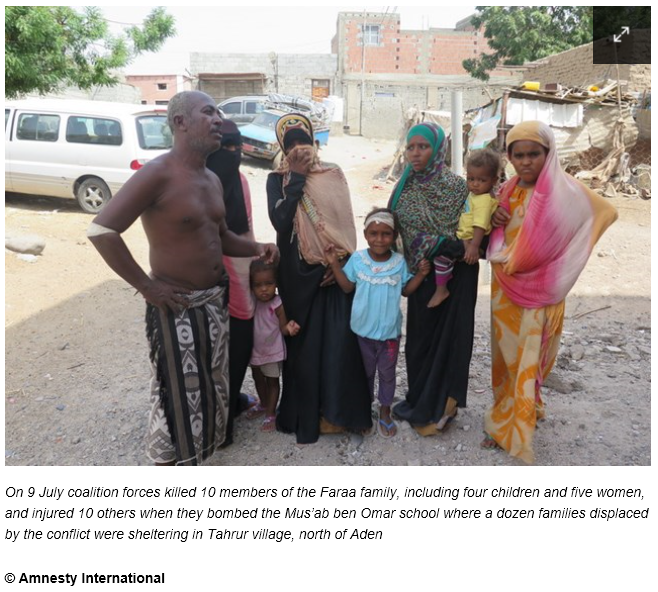
9th July 2015, a Saudi led coalition airstrike hit a school sheltering the displaced in Tahrur village in the Lahj governate north of Aden, Yemen, killing a family of 10 including 4 children and 5 women.
This following is Amnesty's report of the incident:
TAHRUR, LAHJ, 9 JULY
On 9 July coalition forces killed 10 members of the Faraa family, including four children and five women, and injured 10 others when they bombed the Mus’ab ben Omar school where a dozen families displaced by the conflict were sheltering in Tahrur village, north of Aden in Lahj governorate on 9 July at about 1pm. The displaced people who were sheltering in the school are members of the “muhammashin” (marginalised) community – Yemeni citizens of African origins, one of the country’s poorest and most vulnerable communities in the country.
Salama, who lost three daughters, Yusra, 21, Shadia, 19, and Naama, 20 months, in the bombing, told Amnesty International:
“We came here to escape the war in Huta (a 1km west of Tahrur). We had nowhere else to go. We have nothing. How could I imagine that we were going to be killed here? My girls were killed and I wish I had died with them. I have nothing else in life”.
Mehdi Salah Mohammed, a bus driver in the army, was based in Hodeida but has not worked since the beginning of the conflict after his commanding officer stopped reporting to work. To supplement his salary he would make deliveries with his motorcycle. Mehdi told Amnesty International that on 9 July he was out on an errand when an airstrike hit his home, killing his wife, Naama, a mother of seven, and whose 5-year-old daughter Rahma was seriously wounded, said:
“We are just poor people and don’t have anything to do with anything. We have no relations with the Huthis. We fled our homes with nothing and when we tried to go back home to collect some of our clothes the Huthis didn’t even allow us to go. I lost my wife and now our seven children have no mother. What do I tell them? My wife’s sister and niece were killed and their children too are now orphans. May God help us.”
Neighbours told Amnesty International that the last time they saw any Huthis was four days before the strike, when two Huthis passed by the school but did not stop. They said that before the airstrike Huthis used to stay in a school and nearby building in another part of the village, less than a kilometre away. However, that location was never targeted by coalition forces and neighbours said that Huthi/Saleh loyalists armed groups stopped gathering there after the strike on the Mus’ab Ben Omar school, which killed members of the Faraa family. Amnesty International found no evidence indicating that the Mus’ab Ben Omar school was being used for military purposes. All that was visible in the ruins of the school were remains of the meagre possessions of the displaced families who had been sheltering there – blankets, cooking pots, children’s clothes - as well as a fin of a bomb from the Mark 80 series US-designed general purpose bombs, similar to those found at many other locations of coalition strikes.
On 13th June 2015, Saudi led coalition airstrikes targeted a home in al-Safra, south-east of Sa'da city, killing 10 civilians (8 children and 2 women) and injuring 7 more (4 children, 2 women, 1 man).
This is Amnesty International's report of what happened:
DAMMAJ VALLEY, AL-SAFRA, SA’DA, 13 JUNE
On 13 June, coalition forces killed eight children and two women from the al-Sailami family and injured seven other relatives, four children, two women and a man, when they bombed their home in al-Safra, a village south-east of Sa’da city at around 12.30pm.
At the ruins of the house, on the northern edge of the village, Abdullah Ahmed Yahya al-Sailami, whose one-year-old son was killed in the strike, told Amnesty International that he was praying at the nearby mosque with the other men from the family when he heard the bombing and ran back to find a scene of indescribable horror:
“We [the men] were at the mosque at noon prayers, 20 meters from the house. There were 19 people in the house when it was bombed. All but one were women who were not associated with the fighting and children. The children who would usually be playing outside during the day were in the house, because it was lunchtime. They were all killed or injured. One of the dead was a 12-day-old baby, Abdelhakim, and his mother Wafaa, 17. Then we found Sefiya’s body at the entrance of the house, where she was sitting with her two children, three-year-old Youssef and 18-month-old Zahra. All three were killed. It took us three days to dig out their body parts. Youssef was torn to shreds.”
Mohammed, another relative who took part in the rescue after the airstrike, told Amnesty International:
“‘Aqil still had his dummy [pacifier] in his mouth when we pulled him out of the rubble, dead. He was only one year old. That day was his first birthday. Mohammed was 14 months; we found him and his sister Mariam, six, dead in the rubble. When we dug Baraa’, and her sister Juhaina out of the rubble, Juhaina was still alive but she died a few days later, on the first day of Ramadan. She was seven, and Baraa’ was four. The youngest survivor is Abdelmalik, who is only six months old. We found him in the arms of his grandmother Aisha; she folded her body over his and protected him. He was unharmed. She was also injured but thankfully survived. Why on earth did the Saudis bomb our home? This is a farm, we are civilians. There were only women and children. My cousin Ahmad was the only man in the house. He wasn’t feeling well so he did not come to the mosque, but was praying in his room when the house was bombed. When we pulled him from the rubble, injured, he was still praying.”
Amnesty International visited the site three weeks after the airstrike and found at the ruins of the house many items that would normally be found in a civilian house – children’s toys, books, clothes, cooking utensils and furniture. No sign of weapons or other military ware were found in or around the house. Amnesty International did not find any information to suggest that the male residents, who were all, except one, not in the house at the time of the strike, were fighters. At best, this attack demonstrates reckless disregard for the lives of civilians. If the attackers had information that fighters were present, they had a duty to take steps to verify their presence and to ascertain who else was in the house. If necessary precautions had been taken the attack would have been cancelled due to the fact that only civilians were present.
On Friday 3rd April 2015, Saudi led coalition airstrikes hit the village of Hajar Ekah which lies to the West of Bani Matar area in Sanaa, Yemen. 11 civilians were killed, including 2 women and 6 children, the youngest of whom was just 1 day old, and 6 others were injured, including 2 women and 2 children. Other homes were also severely damaged.
This is Amnesty International's report of the incident: Hajr Ukaish village, Beni Matar (Sana’a governorate), 3 April 2015
A
bomb hit three houses belonging to the family of Hussein ‘Abdullah
al-Ukaishi, killing 11 civilians (six children, two women, three men)
and injuring six (two children, two women, two men). Among those killed
was a one-day-old baby who had not yet been named.
Amnesty
International interviewed 10 relatives and neighbours about the
incident. Other residents fled their homes in fear after the airstrike
and sought shelter in the caves in the nearby mountains.
Hussein Abdullah al-Ukaishi’s brother, Ahmed ‘Abdullah al-Ukaishi, 42, told Amnesty International:
“On
that Friday evening, I suddenly heard two explosions in a row that
shook my house. I tried to locate the site of the explosion from my
window, then I saw my brother Hussein’s house had turned into rubble ...
I tried to move to go to his house, but I could not move from my place.
I saw my brother’s house ablaze, all I could imagine was my brother and
family within the flames and the rubble. After putting out the fires,
from 7:30PM to 4AM we tried to rescue who we could.”
According
to Ahmed, there were no hostilities or fighters present in the vicinity
at the time, and Hajr Ukaish village is three to four kilometres north
of the Huthi/Saleh loyalist-controlled Jabal Nabi Shu’aib military base –
which may have been the intended target. The strikes came without prior
warning. He said the first rocket hit the main road, less than 1km
south of the village, and the second was a direct hit on the house.
Hameed
Hussein al-Ukaishi, a family member who was injured inside the house
and has had to resort to living in his neighbour’s house after the
airstrike destroyed their home, said:
The following video by Almasirah TV, taken just after the incident reports 9 civilians killed including 4 children one of whom was 1 day old and injuring 6 others including women and children:
WARNING, the video below is GRAPHIC and DISTRESSING. It
is put here as evidence to support the call for an independent enquiry
into war crimes and to call on the West to stop supplying arms to Saudi
Arabia.
The following initial daily report from the Legal Center for Rights and Development based in Sanaa Yemen, also confirms the above incident of house destroyed and 9 people killed in the Bani Matar area in Sanaa. In addition it also lists an additional 5 people killed and 4 injured in Aden, a house destroyed and 5 people including children injured in Saada, a car destroyed and two people injured in Hajja, and a bridge hit in the Al Mazeriq district of Hajja:
The following more detailed report for the incident was later published by the Legal Center for Rights and Development, confirming 10 people killed including 6 children and 2 women, in addition to 7 people seriously injured.
Saudi/US led air strike on Bani Mattar yesterday killing 9 ppl 6 R children.
On 26th March 2015 coalition air raids were launched on a residential area in Sanaa hitting a residential area close to Sanaa airport (Bani Hawat district). 14 houses were reported as completely destroyed with many more damaged, at least 25 people killed (including at least 6 children and 6 women) and at least 24 injured. 16 cars were also reported as destroyed. WARNING, this video is GRAPHIC and DISTRESSING.
It is put here as evidence to support the call for an independent
enquiry into war crimes and to call on the West to stop supplying arms
to Saudi Arabia.
The following is an excerpt from Amnesty International's report of the incident:
Yemen: Six children among dozens killed in Saudi Arabian-led airstrikes
At least six children under the age of 10 were among a reported 25 people killed in Saudi Arabian-led airstrikes in the Yemeni capital Sana’a early this morning, Amnesty International confirmed after speaking to hospital officials and eyewitnesses.
The organization spoke to medical personnel at four different hospitals where the dead were taken after being pulled from the rubble of 14 houses that were hit in a residential neighbourhood near the city’s international airport. The rest of those killed were men, mostly in their 30s and 40s. It is believed that more people may still be buried beneath the rubble, and at least 20, including four women, were admitted to hospital with mainly shrapnel injures.
...
Yemen’s Ministry of Health today said the airstrikes killed 25 people and injured some 40 – it is not yet known if there were any fighters among the casualties.
According to a paramedic who witnessed the aftermath, the airstrike near the airport occurred shortly before 3AM local time, in a residential area called Beni Hawat. Huthi armed groups had allegedly been operating a checkpoint around 100m away, as well as al-Dailami base around 500m away.
Saudi Arabian officials today stated they had destroyed “all Huthi air defences" at al-Dailami base next to Sana’a International Airport.
Beni Hawat was among a number of sites around the city hit by airstrikes overnight as Saudi Arabia announced it was launching a military intervention by a coalition of 10 countries, including five Gulf Cooperation Council states, against the Huthi armed groups. The US government today stated it had “authorized the provision of logistical and intelligence support” to this military intervention, and other governments, including the UK and Turkey, endorsed the move.
The following is an excerpt from a report by Human Rights Watch concerning the first day of airstrikes:
The Saudi Arabia-led coalition of Arab countries that conducted airstrikes in Yemen on March 26 and 27, 2015, killed at least 11 and possibly as many as 34 civilians during the first day of bombings in Sanaa, the capital, Human Rights Watch said today. The 11 dead included 2 children and 2 women. Saudi and other warplanes also carried out strikes on apparent targets in the cities of Saada, Hodaida, Taiz, and Aden.
Interior Ministry officials linked to Ansar Allah shared with Human Rights Watch details of their final casualty count from the bombings in Sanaa on March 26. They said that warplanes bombed various parts of the city, including Bani Hawat, a predominantly Houthi neighborhood near Sanaa’s international and military airports, and al-Nasr, near the presidential palace. The officials said they had documented that 23 civilians had been killed and 24 wounded. Among the dead were 5 children, ages 2 to 13, 6 women, and an elderly man, they said. The wounded included 12 children, ages 3 to 8, and 2 women.
These numbers are consistent with information provided by two hospitals that Human Rights Watch visited. At the hospitals, Human Rights Watch documented the deaths of 11 civilians, including 2 women and 2 children, whose names were not included among those provided by Interior Ministry officials as well as 14 more wounded, including 3 children and 1 woman.